xinyuanshun@xyspaper.com
+86-13316621858
+86-0750-3766098

A lithium battery fire can spread quickly, release hazardous smoke, produce intense heat, and restart after the visible flames disappear.
The safest response depends on the battery chemistry, size, location, and stage of failure. A small electronic device presents different risks from an electric vehicle, e-bike, or energy-storage battery pack.
For most members of the public, moving away from the battery and contacting emergency services should take priority over attempting to extinguish it.
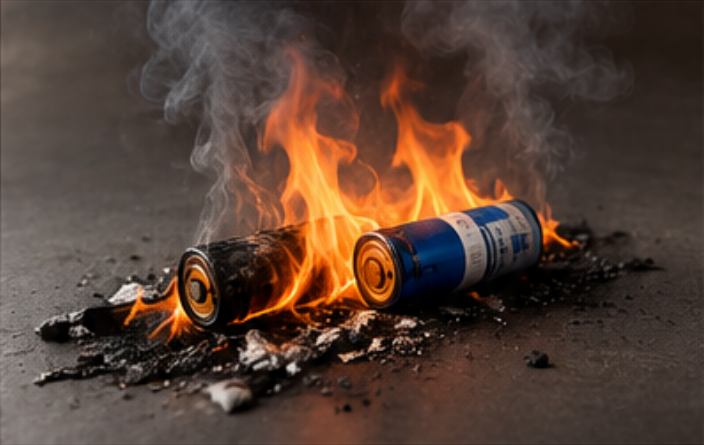
A battery may show signs of failure before flames appear.
Common warning signs include:
Unusual heat
Swelling or deformation
Hissing or cracking sounds
Chemical odor
Smoke or vapor
Liquid leakage
Sudden charging problems
Discoloration around the battery
Stop using and charging the battery when any of these signs appear.
A swollen or damaged battery should not be cut, punctured, bent, or placed under pressure.
Mechanical damage may create an internal short circuit and increase the risk of thermal runaway.
Move away from the battery immediately and warn other people nearby.
Contact the local fire and emergency service, especially when the battery is indoors, attached to an e-bike, located near an exit, or close to combustible materials.
Do not attempt to carry a smoking battery through an occupied building. Movement may expose you to flame, hot material, toxic gases, or sudden failure.
Leave the room or building and close the door when this can be done safely.
Do not allow the battery or burning equipment to block stairs, corridors, doors, or other escape routes.
Smoke from a failing lithium-ion battery may contain hazardous gases and particles.
Move to fresh air and seek medical assistance when smoke inhalation causes coughing, breathing difficulty, dizziness, or eye irritation.
Firefighters may use large quantities of water to cool rechargeable lithium-ion battery cells and surrounding materials.
Cooling is important because heat can spread from one cell to another, and damaged cells may restart after the visible fire appears to be extinguished.
Members of the public should not approach a large battery fire simply because trained firefighters may use water.
An extinguisher should only be used when:
The fire is very small
You have suitable training
You have the correct equipment
A clear exit remains behind you
Emergency services have been contacted
Local safety guidance permits intervention
Leave immediately if the fire grows, produces heavy smoke, or involves multiple cells.
Rechargeable lithium-ion batteries are different from non-rechargeable batteries containing metallic lithium.
Metallic lithium may react dangerously with water and normally requires a suitable Class D extinguishing agent handled by trained personnel.
When the battery chemistry is unknown, do not experiment with extinguishing materials.
Yes. A damaged battery may continue generating heat internally after the visible flames disappear.
Do not touch, move, recharge, or place the battery in household waste after a fire.
Keep people away and allow emergency professionals to inspect, isolate, and arrange safe disposal of the damaged battery.
A Li Ion battery separator is positioned between the positive and negative electrodes inside a lithium-ion cell.
Its main purpose is to prevent direct electrical contact between the electrodes while allowing lithium ions to move through the electrolyte.
Important separator properties may include:
Electrical insulation
Ion permeability
Thickness consistency
Puncture resistance
Dimensional stability
Electrolyte compatibility
Surface cleanliness
Mechanical strength
The separator can help reduce the risk of internal electrode contact, but it cannot prevent every battery failure.
Battery design, charging control, thermal management, cell manufacturing, mechanical protection, and the battery-management system are also important.
We supply PP- and PE-based separator materials with customizable width and thickness.
Our production and service system supports material processing, warehousing, distribution, technical coordination, OEM, ODM, and international supply.
Separator rolls can be packed according to the buyer’s handling and transportation requirements to reduce folding, impact, contamination, and surface damage.
Developing lithium-ion cells for electronics, mobility products, industrial equipment, or energy-storage applications?
Provide the battery chemistry, separator width, thickness, porosity target, mechanical requirements, winding process, packaging method, and purchasing quantity. We will prepare a li ion battery separator proposal for technical evaluation.
Previous: How Long Does A Lithium Batteries Last?