xinyuanshun@xyspaper.com
+86-13316621858
+86-0750-3766098

Straw wrappers look simple, but the material choice behind them affects waste handling, customer expectations, and even brand perception in foodservice. Some wrappers break down naturally under the right conditions, while others behave like mixed packaging and require different disposal routes. This article explains what biodegradability really means for straw wrappers, how to judge different wrapper structures, and how to choose a practical, export-ready option that fits real-world use.
If you are sourcing food-contact paper for packaging and wrapping, you can also review XINYUANSHUN solutions here: food paper products
Many buyers assume biodegradable equals disappears in nature quickly. In practice, biodegradability depends on four factors:
Material chemistry: cellulose fibers behave differently from plastic films and synthetic coatings
Environment: industrial compost, home compost, soil, freshwater, and marine conditions are not the same
Time: some materials break down in months under controlled composting, but persist for years in landfills
Verification: claims should be tied to recognized test methods and product-level evidence
A wrapper can be mostly paper and still fail a biodegradability expectation if it contains a barrier layer designed for moisture resistance. Conversely, a wrapper designed for compostability may still not break down well if it ends up in a dry landfill or incineration stream. So the right question is not only is it biodegradable, but also where will it go after use.
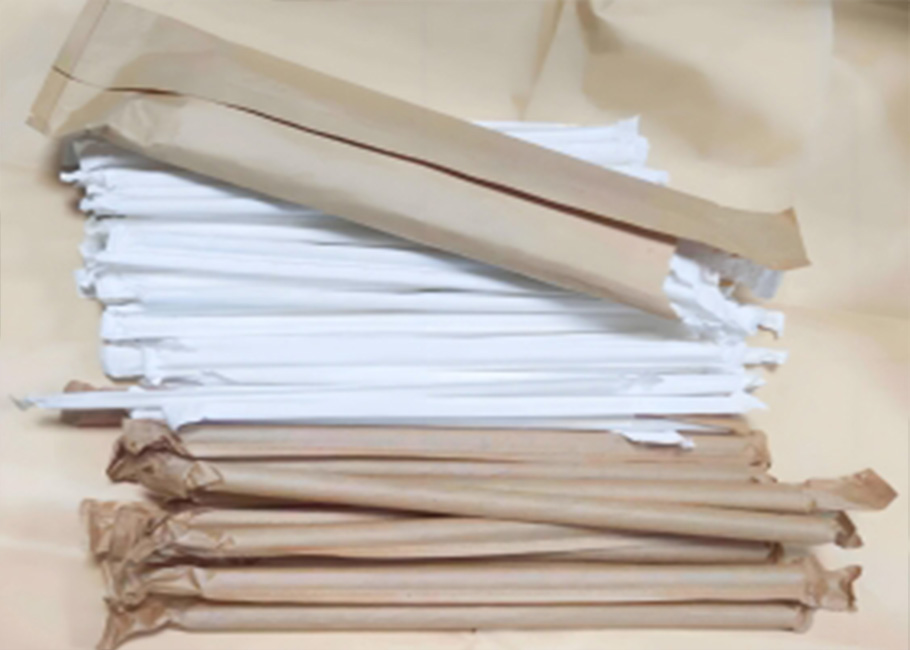
In global foodservice, straw wrappers usually fall into a few common structures. Each structure solves a real performance issue, such as water resistance, tear strength, or hygiene during transport.
Paper only: best for fiber recycling and biodegradation in wet biological environments, but weaker moisture resistance and can tear during high-speed packing
Paper with thin polymer barrier: improved water resistance and tensile strength, but becomes a composite that is harder to compost and harder to recycle if layers are not separable
Biopolymer film wrappers: marketed as compostable in some markets, but performance and certification requirements vary widely
Wax or coated paper: can provide slip and moisture control, but the coating determines disposal options
XINYUANSHUN focuses on Food Paper structures designed for real packaging lines and end-use handling, including paper plus PE solutions that balance tear resistance, water resistance, and stable converting performance for food packaging supply chains. You can explore the product range here: food paper products
Below is a practical comparison that procurement teams often use when matching wrapper types to disposal systems and operating conditions.
| Wrapper structure | Moisture resistance | Packing line robustness | Typical biodegradability outcome | Recycling practicality | Best-fit scenarios |
|---|---|---|---|---|---|
| Paper only | Medium to low | Medium | High potential in composting and natural biodegradation environments | High in clean paper streams | Dry storage, low condensation risk, short logistics |
| Paper plus PE | High | High | Paper portion biodegrades, PE layer does not biodegrade in most environments | Limited, depends on local composite acceptance | Cold drinks, humidity exposure, long transport, high-speed packing |
| Compostable biopolymer film | Medium to high | Medium | Can be compostable in industrial systems if certified | Often not accepted in paper recycling | Markets with strong industrial compost collection |
| Wax or specialty coated paper | Medium | Medium | Depends on coating chemistry and thickness | Often limited | Niche use where slip and barrier are critical |
Key takeaway for buyers: many straw wrappers are not fully biodegradable as a complete structure, even if they look like paper. Performance-driven barrier layers are the usual reason.
To evaluate biodegradability responsibly, avoid relying on appearance, color, or supplier wording alone. Instead, check three layers of evidence.
Structure disclosure
Ask whether the wrapper is paper only or paper with barrier lamination. Paper plus PE is common for improved strength and waterproofing.
Test and certification alignment
A biodegradable or compostable claim should connect to recognized standards used in the target market. Certifications are most useful when they match the disposal system your customers actually have.
Use-case matching
If your end users store straws in humid environments, transport across long routes, or run automated packing, a paper-only wrapper may fail in performance and create more waste through damage and rework. In that case, a high-strength barrier structure may be the more sustainable choice in practice because it reduces spoilage, rejects, and secondary packaging needs.
XINYUANSHUN can support this evaluation with stable specifications and customization so the wrapper matches both performance needs and material expectations. For example, paper plus PE structures can be produced with controlled material thickness and consistent converting behavior, supporting efficient packaging operations. See options here: food paper products
It is important to be transparent: paper plus PE straw wrappers are generally not fully biodegradable as a whole, because the PE layer does not biodegrade in most natural or composting environments. However, this structure exists for practical reasons that affect total waste.
Water resistance reduces wrapper failure around cold beverages, condensation, and kitchen humidity
High tensile strength reduces tearing during transport and during packing line friction
Stable hygiene barrier helps keep straws clean through longer logistics and multi-stop distribution
Lower damage rate means fewer rewraps, fewer rejected bundles, and less secondary packaging
From a sustainability perspective, many foodservice operators choose paper plus PE when operational losses from paper-only wrappers create a bigger waste footprint than the wrapper material itself. A well-made wrapper that survives the full supply chain can reduce overall material consumption.
XINYUANSHUN designs its food paper for the packaging industry where buyers frequently require good tensile performance, strong environmental adaptability, and waterproof properties, especially for high-volume distribution. This is the same performance logic behind reliable straw wrapper paper.
Even the best material design can underperform if disposal is mismatched. Here is how straw wrappers typically behave in common waste routes.
Industrial composting
Paper-only wrappers can break down well. Composite paper plus PE typically does not meet composting expectations unless specially engineered and certified for compostability.
Paper recycling
Clean paper-only wrappers may be recyclable if they are collected as dry paper. In many real settings, straw wrappers are contaminated or too small to be captured efficiently. Composite structures may be rejected by paper mills depending on local screening and pulping systems.
Landfill
Landfills are often dry and low-oxygen. Biodegradation slows dramatically. Even biodegradable materials may persist for long periods, which is why landfill is not a good test environment for biodegradability claims.
Incineration or energy recovery
This route depends on local policy. Material choice influences emissions management requirements and cost.
For exporters, the correct approach is to match wrapper structure to the destination market’s collection system and customer use-case. If the destination lacks compost collection, a compostable claim adds little value. If humidity and transport are the main issue, durability may be the deciding factor.
When sourcing straw wrapper paper or related food Packaging Paper, buyers usually care about reliability as much as sustainability. XINYUANSHUN advantages align with typical procurement priorities:
Food packaging focus
Product development is aligned with food packaging needs, including barrier performance and handling stability. Explore the range: food paper products
Balanced structure options
Paper plus PE structures support waterproof performance and strong tensile behavior, reducing tearing and damage during packing and logistics.
OEM customization
Material width and thickness can be tailored to customer requirements, supporting different converting machines and packaging formats.
Consistent packaging and shipment readiness
Carton packing supports safe international transport and warehouse handling.
Supply chain practicality
A wrapper is only sustainable if it works at scale. Stable quality, controlled specs, and dependable lead times reduce rework, returns, and wasted inventory.
These points help importers and distributors avoid common problems such as torn wrappers, moisture failure, inconsistent roll behavior, and packaging line downtime.
Some straw wrappers are biodegradable, especially paper-only structures under the right biological conditions. Many commonly used wrappers are not fully biodegradable because they include barrier layers that improve water resistance and strength, such as paper plus PE. The best choice depends on where the wrapper will end up after use and what conditions it must survive before disposal.
If you need straw wrapper paper that performs reliably in humid environments, supports high-speed packing, and protects hygiene through long logistics, XINYUANSHUN food paper solutions provide practical structures with customization support. You can review the available materials here: food paper products